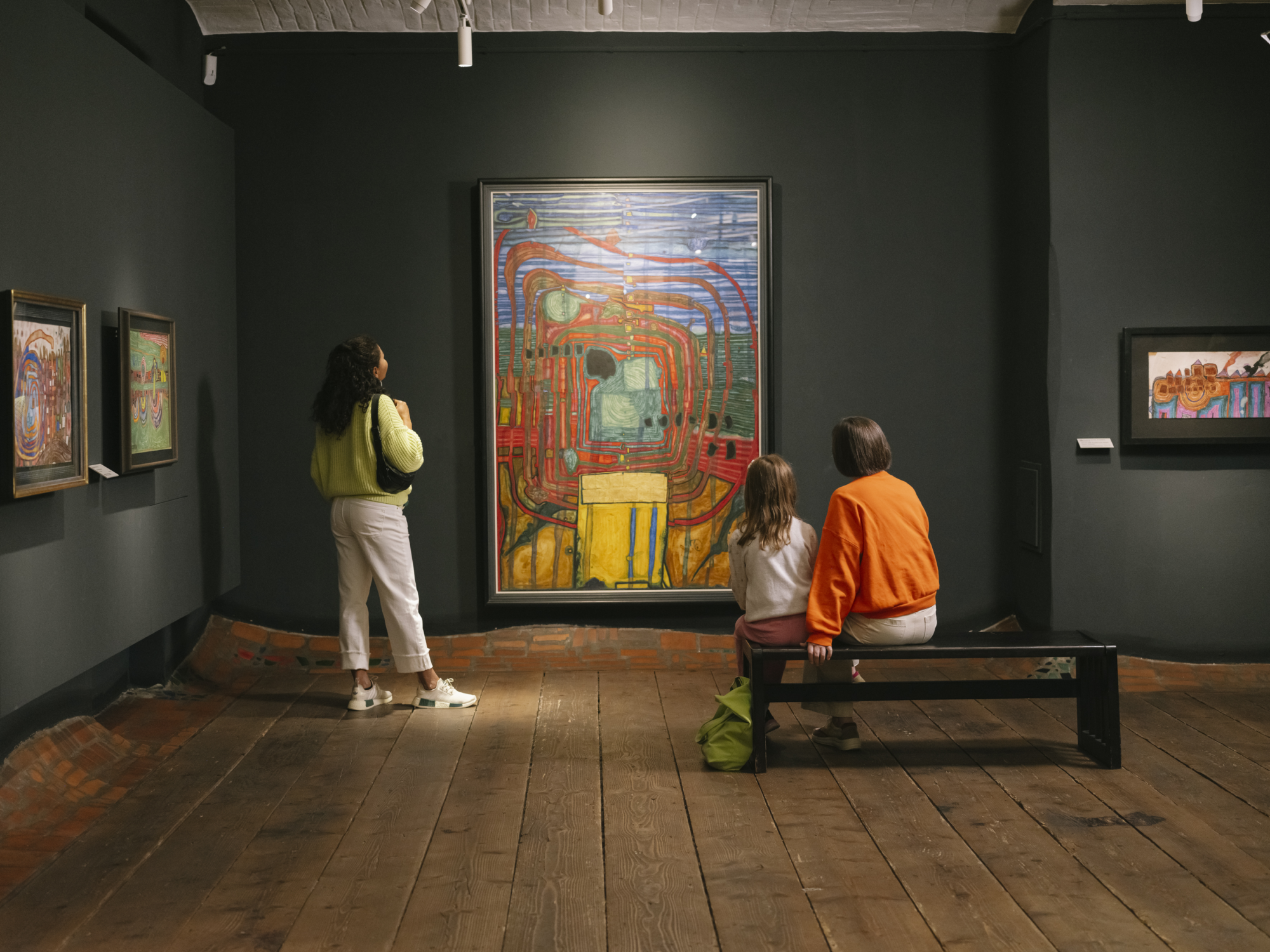
The spiral, as I see it, is a vegetative spiral, with swellings, where the lines become thicker and thinner, like the rings of a tree trunk…
Friedensreich Hundertwasser, The Spiral, 1974
A major part of the effect of Hundertwasser's painting is color. Hundertwasser uses colors instinctively, without associating them with any sort of symbolism, either traditional or self-invented. He prefers intense, radiant colors and loves to place complementary colours next to one another to emphasize, for example, the double movement of a spiral. He also likes to use gold and silver foil, which he places directly on to the picture.
Two large groups of motifs determine the content of Hundertwasser's painting. One comprises a world of forms analogous to vegetative growth as animistic nature; the other is the repetitive use of architectural signs: houses, windows, gables, fences, gates, etc. It is one of the idiosyncrasies of Hundertwasser's art that both motif groups are inextricably linked: vegetative forms seem static and solid – like architecture – as if they were meant to last; whereas everything constructed seems to have grown organically and to have been produced by nature herself.
His painting technique is also a very personal affair. Hundertwasser likes best to use paints he has pulverised or prepared himself, and which he then applies without mixing. Similarly, he prepares the priming ground himself; for prime coating, paint mixing and varnishing he has developed various recipes of his own, all of which are designed to guarantee a long life to his pictures.
In many of his works he uses oil, tempera and watercolour techniques in order to achieve a contrasting effect between the matte and radiant parts of the picture.
Wieland Schmied, in: Hundertwasser – KunstHausWien (Cologne, 1999)