Logo image of the KunstHausWien

Loading

  • Home  >
  • Sustainability  >
  • Sustainability Concept

  • KunstHausWien – Sustainability Concept

    For us, sustainability is more than just a goal: Our sustainability concept brings together the measures we are taking to gradually make the KunstHausWien sustainable for the future.

    KunstHausWien. A Museum Takes Responsibility

    The museum as a producer of values: In the spirit of this sociopolitical responsibility, as a public institution we at the KunstHausWien place great value on sustainable action in our operational running, a logical complement to our focus on art and ecology. We set up and operate both our visible and invisible processes in-house according to the highest possible ecological standards. In 2018 the first museum to be awarded the Austrian Ecolabel, since then we have set new environmental standards in organising events and campaigns, so too in our lived everyday routine, looking to inspire others in the culture sector and society. We are continuously working on further developing our goals and the best means to reflect on the pathways necessary to reach these goals.

    Thematic Orientation 

    Reflection – Inspiration - Vision
     

    Our thematic orientation on ecological issues as a sociopolitical mission: We at the KunstHausWien work with the means of art to create a more sustainable future for all.

    The Museum’s Programme
    The KunstHausWien debates environmental and sustainability issues within the art discourse. Exhibition events focus on contemporary multimedia art that engages with themes pivotal to ecology and sustainability. We combine such an engagement with an interdisciplinary discourse programme that builds on and takes discussions further.

    Communication Internal and External
    At the KunstHausWien sustainability features prominently in the museum’s guiding principles and our quality management.

    Our employees are purposefully and actively integrated into the sustainability process. This is above all evident in our efficient usage of materials, in how we monitor and implement our waste management concept as well as our energy efficiency and paper consumption. One task of our Green Team is to regularly compile process documentation and define objectives.

    As part of Vienna’s cultural landscape, the museum also plays a multiplicator role externally. Appreciative of the importance of this role, we create and organisationally anchor communication channels which prominently position in society both the museum’s engagement as well as the goals of a sustainable future, while at the same time reinforcing network structures.

    Art and Science
    An important aspect of the museum’s work is to engage with approaches taken by other disciplines, together with constantly reflecting on our own work. The KunstHausWien is therefore consciously looking to cooperate with science and scholarship, for example within the framework of the newly created Klima Biennale – which the museum organises – or in a cooperative teaching event with the Vienna University of Applied Arts.

    Building & Facilities 

    Living with Trees and Water


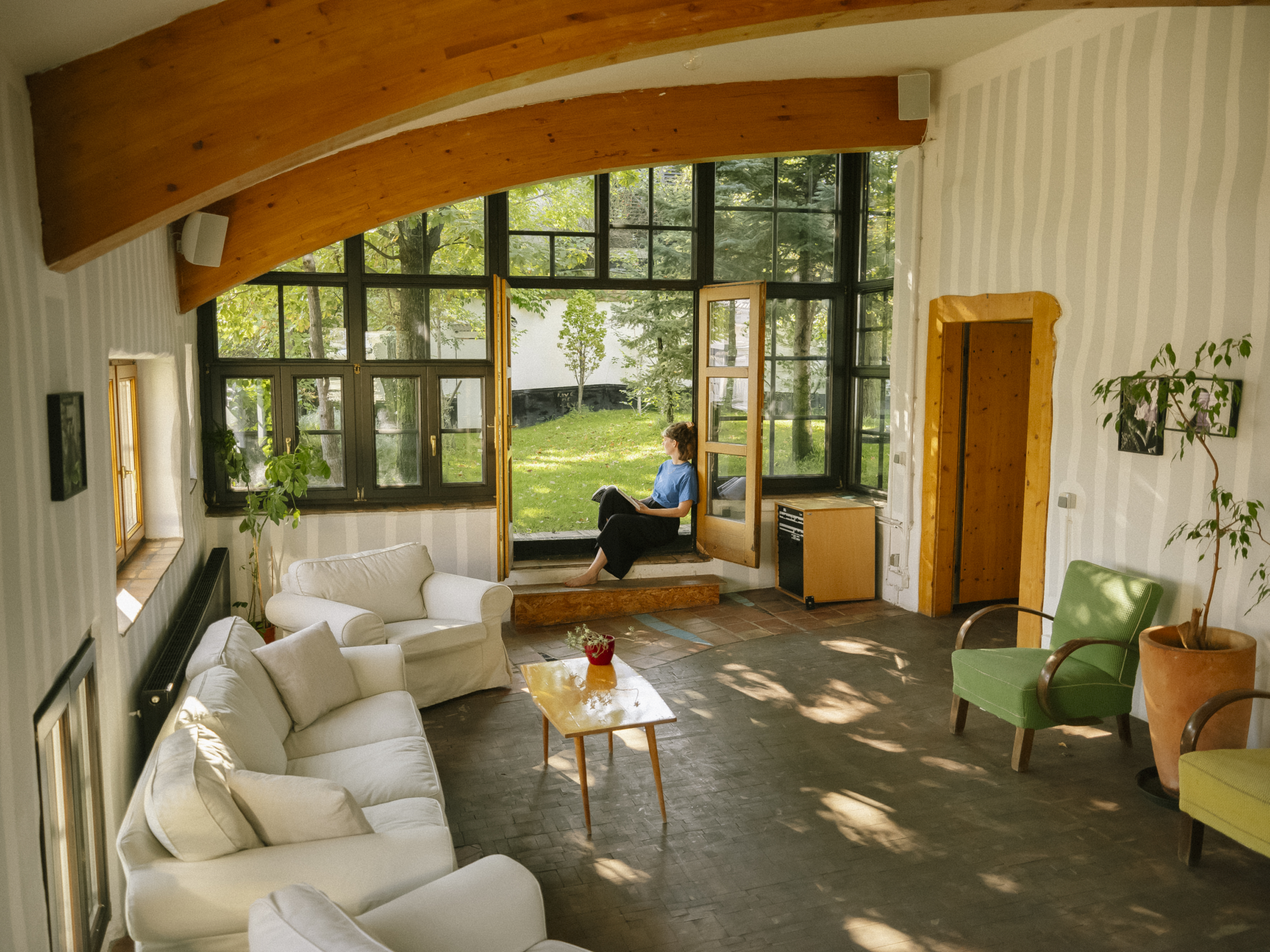
    In 1991 Friedensreich Hundertwasser designed the KunstHausWien as his ideal museum. Art and nature in perfect harmony: We have taken up Hundertwasser’s philosophical and architectural principle and carry it forward, integrating the latest knowledge in sustainable building and living. Our energy supply and the renewal of the building technology meet state-of-the-art sustainability criteria.

    Hydrothermal Changeover
    Thanks to changing over to hydrothermal heating (utilising groundwater) as the source for generating energy in 2024, the KunstHausWien has successfully phased out power sources producing CO2. In comparison to the original temperature-controlled surface, this has enabled us to reduce our energy consumption by 75%.

    Cistern
    An underground cistern capable of holding up to 8000 litres of groundwater enables the environmentally-friendly watering of the around 260 plant species in and on the building and grounds created by Friedensreich Hundertwasser.

    Facilities
    Since 2024 the museum is equipped with LED lighting. As part of our renovations, the museum’s planting concept was also complet<ely renewed and since then regularly monitored and improved. This serves as a natural cooling system and contributes to improved air quality in the building.

    Barrier-free Visit
    The unique architecture of the building features uneven floors in some places. Nevertheless, at the KunstHausWien we do what we can to ensure that all visitors can explore our museum without any problems. The barrier-free access via the side entrance with an automatic sliding door makes entering the building easy. Once inside, a tactile floor map in the foyer helps visitors to gain an orientation on the ground floor. All areas open to the public, including the café and shop, are accessible barrier-free. All exhibition levels are reached conveniently by using the lift.

    Sustainable Use of Resources

    Reduce – Reuse – Recycle
     

    In our use of resources we apply the following priorities in all areas: 1. In general reduce, 2. Repair and reuse existing resources, 3. Recycle accumulating resources. When purchasing new products consideration is given to a long operating life, recycled raw materials and ecological compatibility.

    Sustainable Purchasing
    Purchases for everyday office work, for the museum and for the museum shop follow the supply chain. This implies reviewing delivery companies to identify how they have procured their materials and upstream products, the return of scrap materials and excess products as well as acquiring environmental-friendly office materials.

    Paper Consumption
    The essential prerequisite for reducing the amount of paper used is to print more sparingly. Simply questioning the necessity of printing helps to save paper. Faulty print outs are collected and used as jotting paper. Print offs requiring several pages are reduced to fit a single page and/ or double-page settings are used. The printing function “print markups” prevents an excess printing of pages. The print preview also contributes to reducing a flood of paper.

    Using Recycled Paper
    Print paper, flipchart paper, post-it notes and other office paper are all made out of recycled materials.

    Office Equipment (photocopiers etc)
    Except for the laptops and PCs of staff, there are no single devices at the respective workplaces. Devices are repaired when defect. Principally our practice is: Repairing has priority over new purchases. For the everyday office routine three central printers and photocopiers are available to the team.

    Print cartridges are collected; empty print cartridges are sent away once a month to be refilled. There is no disposal in the general waste.

    We turn off all devices at the end of the working day and only turn them on again before the first copying of the day is needed. It is our principle to press the power save mode button after copying – this alone brings electricity savings of up to 15%.

    Cleaning Products
    The KunstHausWien is committed to using purely biodegradable cleaning products. They are purchased through a collective order and the packaging is disposed in an ecologically-responsible way. Water-saving technologies and practices are used in all cleaning activities and the sanitary facilities.

    General Waste Concept

    Must Haves and Beyond
     

    The KunstHausWien acts as an internal control and planning instrument within a general waste management concept. Besides documenting the waste management necessary for daily operations, the focus is on raising awareness amongst the waste producers and convincing them to actively assume responsibility for producing less waste.

    …in the office
    The office has a central wastepaper collection point. Each single office room has a general waste bin. A central waste sorting station in the respective community office enables the separation of general waste, organic waste, scrap paper, plastics and scrap metal. A collection box for batteries is also available.

    Whenever necessary, a staff member disposes the organic waste in the museum’s general organic waste container. Once a week the cleaner removes all the collected waste and places it separately in the designated containers in the museum or on the street.

    …in the museum
    We dispose of the waste produced in museum operations according to the principles of the waste management concept, i.e. in a general refuse bin, two waste paper containers, an organic waste container and a glass collection point, while there is also a bin for cooking oil used in the gastronomy. General waste is collected three times a week, the organic waste container is emptied twice a week and scrap paper once a week. Glass and the used cooking oil are collected as needed, usually every fortnight.

    The KunstHausWien bases its waste disposal concept on the ‘Mist-ABC’, the City of Vienna’s waste guidelines.

    Planning Exhibitions in an Ecofriendly and Sustainable Way

    What we show is who we are.
     

    We think of exhibitions in the KunstHausWien as climate-friendly processes, from curating and the organisational and logistical planning through to production and design.

    When selecting works of art it is important to us that long transport routes are avoided. Transports are carried out mainly as combined additional cargoes. Wherever possible, we make use of postal services and inner-city transportation with bicycle couriers or public transport. All persons involved in an exhibition are encouraged to use only recyclable packaging material. When designing the exhibition, if possible, we forgo using large architectural installations. Materials usage is held to a minimum. Any new purpose-built exhibition furniture is reutilised for future productions or made out of recycled materials. For exhibition lettering and labelling we use foil stencils and cuts and ensure that the material contains no PVC, plasticisers, chlorine and solvents; we also use a CO2-neutral produced cardboard from an ecofriendly forestry operation. Accompanying exhibition publications are produced to meet the highest requirements of ecofriendly printing and the strictest application of recycling principles.

    Mobility

    Reducing CO2 Emissions
     

    A museum visit is then ecofriendly all round when getting to and from the art on show emits as little CO2 as possible. The KunstHausWien provides visitors and staff with the necessary information and incentives to travel in a way that keeps CO2 at a minimum.

    Museum Visitors are made aware of the various possibilities to reach us by public transport or bicycle on the KunstHausWien website. With the Vienna City Card, primarily tourists benefit from reduced admission to the museum upon purchasing a 7-day ticket.

    Employee Mobility
    Bicycle racks, located in front of the office and the museum, are available for our employees. We recommend that they preferably travel to and from work with public transport or ride a bicycle. The Wien Holding regularly collects relevant data on the mobility of the team and presents an appraisal.

    Trips on official museum business are undertaken only when 1) absolutely necessary, and 2) if necessary, conform to the highest possible ecological standards. Air travel is principally avoided when alternatives are possible. Automobiles are only used when a group is required to travel.

    Events

    Green Events Certification


    The KunstHausWien plans events on its premises based on the Green Events criteria. In 2025 we are additionally aiming to gain certification as a licenser for the events of other institutions and companies.

    The following criteria have already been met:

    • Regional, seasonal and organic-certified food for catering

    • Waste prevention by food sharing and/or in-house circulation

    • Using sustainable and ecological cleaning and hygiene products

    • Ecologically efficient and responsible use of energy, water and cleaning agents

    • Encouraging participation and feedback opportunities for visitors and staff

    • Implementation of a waste management concept

    • When selecting partners, we pay attention to regionality, short transport routes and quality organic products (e.g. Ströck, Greek Oil Company, Mehofer)

    • Accommodation for our guests in hotels also awarded the Ecolabel

    • Barrier-free access to all the function rooms of an event

    • Café Friedlich, our long-term cooperation partner, is aiming to be certified with the Ecolabel by 2026 and is already systematically implementing the criteria for Green Events.

    Catering Partners & Sponsors
    For internal events the museum works together with Café Friedlich, whose culinary creations and refreshments are based on the principles of regionality and sustainability. Café Friedlich itself is striving to gain the Ecolabel in 2026. Further partners or in-kind sponsors like winemakers, producers, bakeries or service providers are encouraged to respect and observe the museum’s sustainability criteria.

    Social Sustainability

    Code of Conduct
     

    We understand sustainability not only as an ecological requirement but also as a social prerequisite for constructive, mutually appreciative and future-oriented work. This includes fair working conditions characterised by respect for diversity and employee rights as well as a collegial and polite tone when talking with one another.

    An existing Code of Conduct formulated by the Wien Holding is in force at the KunstHausWien as a company of the holding. Beyond this, the museum is constantly refining and reviewing its own criteria for collaborative work and will draw up its own in-house Code of Conduct in the course of 2025.

    Reflection und Monitoring

    Control is Better
     

    As museum operators, exhibition creators and organisers, service providers and value producers, it is important to us to continually scrutinise our actions, to reflect on the usual in-house processes and to resolutely move towards climate neutrality. Most important though is to be aware that we have still some way to go before achieving our goal. The museum possesses the Austrian Ecolabel since 2018 and via the Wien Holding is subject to the CSRD reporting obligations.

    Austrian Ecolabel
    In 2018 the KunstHausWien was the first museum to be awarded the Austrian Ecolabel and since then we are a licensed “Green Museum”. To maintain this status, an interim audit needs to be passed every two years, while a new full review follows every four years, with recertification issued if all criteria are met.

    CSRD Reporting Obligation as Part of the Wien Holding
    As part of the Wien Holding, the KunstHausWien has an obligation to report in the context of the EU’s Corporate Sustainability Reporting Directive (CSRD). For the sustainability team of the Wien Holding, a CO2 balance (“carbon footprint”) is also compiled and presented in a sustainability report. The results are published in the Wien Holding’s annual report.

    Feedback

    If you have any questions or suggestions, please write to us at: info@kunsthauswien.com.

    With the KunstHausWien newsletter you will receive current museum news, invitations to openings and events, as well as information about our educational programs.